 Nexiode





Home > Resources > Case studies >
Valence Romans cycle path – Dynamic lighting with communication detection

The territory and its identity
Valence Romans Agglo is part of a strong movement towards sustainable transport. For several years, the region has been investing in infrastructure that promotes cycling, with the aim of providing continuous, safe, and attractive routes, including at night.
The bike path in question is located in a suburban, natural environment, where lighting must strike a delicate balance: ensuring user safety while limiting energy consumption and environmental impact.
Initial challenges and findings
Lighting for bike paths poses specific challenges. Unlike traditional urban roads, traffic flows are intermittent and vary greatly depending on the time of day, season, and weather conditions.
Permanent full-power lighting therefore appears unsuitable: it consumes a lot of energy, is not very environmentally friendly, and is sometimes excessive in relation to actual usage.
The community therefore wanted a solution that could automatically adapt to the presence of users, while ensuring a high level of safety for cyclists.
A shared vision and clear objectives
The project led by Valence Romans Agglo is based on a simple yet ambitious vision: providing the right lighting, at the right time, at the right level.
The objectives were clearly defined:
enhance the safety and comfort of cyclists,
significantly reduce energy consumption,
limit the impact of light on the environment,
offer a robust and sustainable solution that can be integrated into an overall smart lighting strategy.
Lighting becomes a dynamic service here, closely aligned with actual usage.
The approach and support
The project was carried out in close collaboration between the local authority, the construction partners (Guintoli, SPIE, NGE – BTP) and the Eclatec teams, under the leadership of the CIT'EQUIPE agency.
From the design phase onwards, consideration was given to integrating detection into the lighting system in order to ensure a seamless, reliable, and easy-to-use solution.
The support provided enabled the detection and light variation parameters to be finely tuned to the specific characteristics of the site and the expectations of users.
- The Nexiode solution deployed
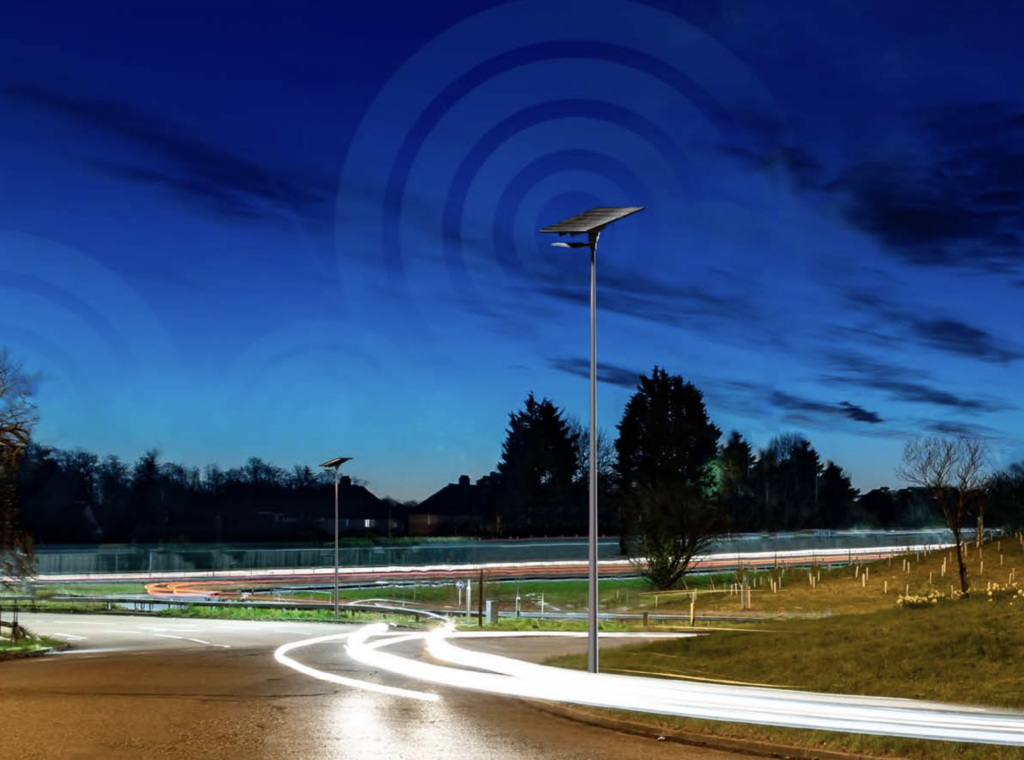
The bike path is equipped with LED lights that have built-in smart presence detectors connected to a smart control system.
Each light point is capable of detecting the passage of a cyclist and transmitting the information to neighboring lights, creating dynamic, progressive lighting that accompanies the user throughout their journey.
The solution is based on a decentralized, robust, and scalable approach that is perfectly suited to linear infrastructures such as bike paths.
Key features and practical uses
In concrete terms, the system operates at several intensity levels:
a reduced basic level in the absence of users,
a gradual increase in illumination when a cyclist is detected,
temporary maintenance of the reinforced level in the passage area,
an automatic return to the low level after passing through.
This approach ensures optimal visibility without unnecessary lighting, while providing a smooth and reassuring experience for cyclists.
Results and benefits observed
The benefits are numerous and immediately noticeable:
significant improvement in safety and user comfort,
significant reduction in energy consumption,
better integration into the landscape and reduction of light pollution,
promoting more attractive and sustainable soft mobility.
Communicative detection optimizes lighting without compromising safety, adapting in real time to usage patterns.
A scalable solution for sustainable mobility
This project perfectly illustrates how smart lighting can support sustainable mobility policies.
Communicative detection provides an evolving foundation that can be enhanced in the future with new services or usage analyses, and integrated into a broader smart territory strategy.
With this bike path, Valence Romans Agglo demonstrates that it is possible to combine safety, energy efficiency, and respect for the environment by putting technology at the service of users.
Discover also